The first veterinary appointment specifically about your dog's hips can feel overwhelming if you do not know what to expect. Veterinary orthopedic examination has a language of its own, and the imaging findings that will be discussed involve terminology that is unfamiliar to most owners. Walking in prepared makes a meaningful difference in what you get out of the visit.
Whether this is your first concern about possible dysplasia or you are seeing a specialist after a general practitioner's diagnosis, understanding the diagnostic process helps you ask better questions and leave with clearer understanding of your dog's specific situation.
The Clinical Examination: Before Any Imaging
Diagnosis begins before any X-rays are taken. A thorough clinical examination provides information that imaging alone cannot, and it guides the choice of what imaging to pursue and how to interpret it.
Gait analysis: Your veterinarian will watch your dog move. Ideally this is on a surface that allows natural movement, not a slippery examination room floor. The examiner is observing stride length, symmetry between limbs, weight-bearing patterns, and characteristic gaits associated with hip pathology like the bunny hop or hip sway. Some practices use pressure mat systems or force plates for objective gait data.
Muscle palpation: Both hindlimbs are palpated to assess muscle mass and symmetry. Significant asymmetry, one side considerably more muscled than the other, indicates chronic disuse of the more atrophied limb. The examiner also notes tone and tenderness in specific muscle groups.
Range of motion assessment: The hip joint is taken through its range of motion with the dog lying down. The examiner notes the extent of flexion and extension available, whether movement in any direction produces pain responses, and whether there is any crepitus, a grinding or clicking sensation, felt through the joint during movement.
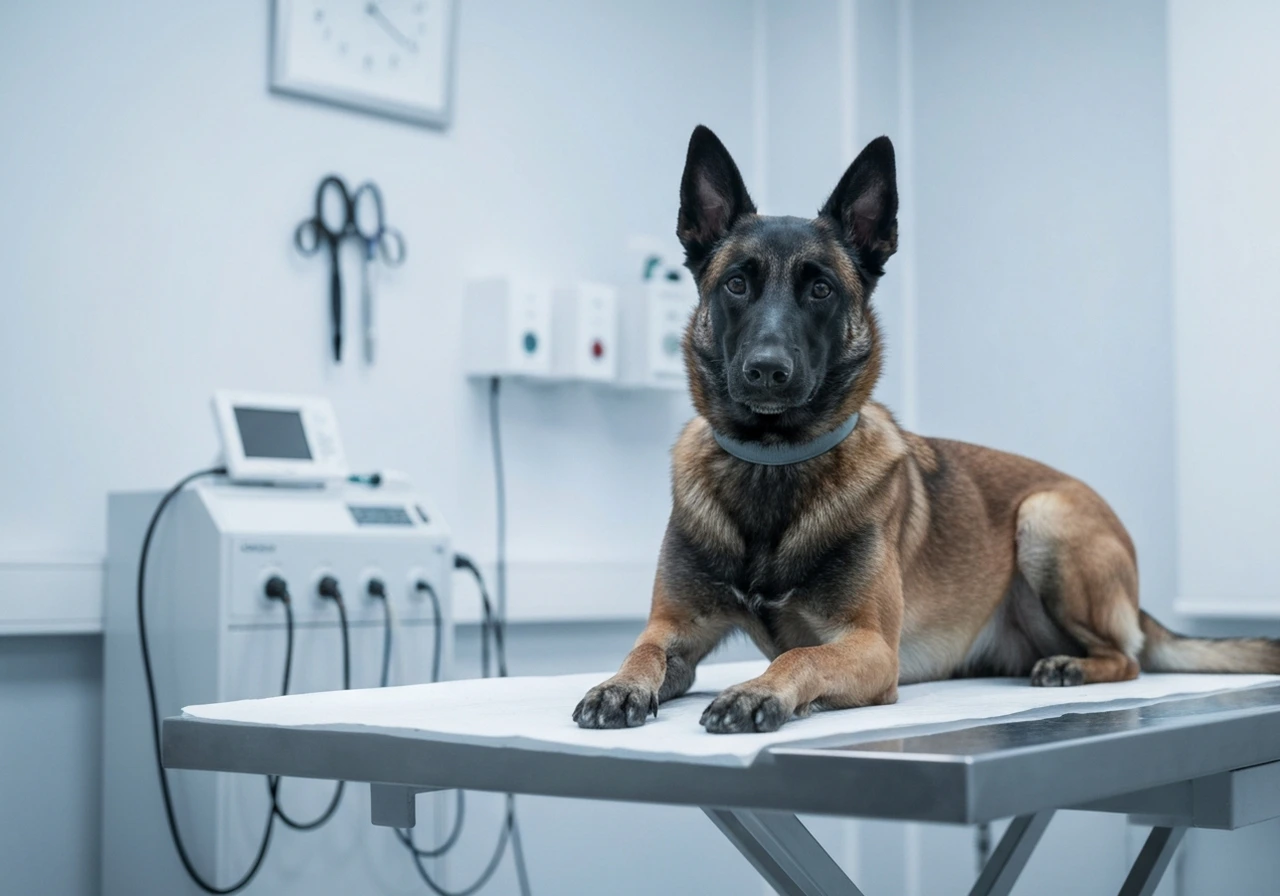
Ortolani and Barlow tests: These specific manipulative tests assess hip joint laxity. The Ortolani test involves applying pressure along the femoral axis while simultaneously pushing the femur dorsally. In a dysplastic hip, this subluxates the femoral head. Abducting the leg then produces the characteristic Ortolani clunk as the head reduces back into the socket. A positive Ortolani indicates significant joint laxity. These tests are most reliable with the dog sedated or deeply relaxed.
Radiography: What the Images Show
Hip radiographs are the primary imaging modality for hip dysplasia diagnosis. Understanding what is being assessed on the films helps you make sense of the report.
Hip-extended ventrodorsal view: The standard view for OFA evaluation. The dog lies on their back with both rear legs extended and pulled toward the tail. This position shows the femoral head and acetabulum in a specific orientation that allows assessment of socket coverage, femoral head shape, and the degree of arthritic change present.
The radiologist or veterinarian evaluating this view is looking for:
- The depth and shape of the acetabulum: does it cup the femoral head deeply or shallowly?
- The shape of the femoral head: round and smooth or irregular and flattened?
- Subluxation: is the femoral head fully seated or displaced from the socket?
- Osteophytes: bony growths around the joint margins indicating arthritic response
- Subchondral bone changes: sclerosis or erosion indicating cartilage loss
- Morgan's line: a specific finding associated with hip dysplasia
Distraction radiography (PennHIP): The PennHIP method uses a specialized distraction device to apply controlled stress to the hip during imaging. This produces a distraction index, a number from zero to one representing femoral head displacement relative to the socket diameter. Higher distraction index indicates more laxity and greater risk of developing clinical dysplasia. PennHIP is particularly valuable in younger dogs where the structural changes of established dysplasia have not yet developed.
Understanding the Report
After examination and imaging, your veterinarian will summarize findings. The language used in these summaries can be confusing. Key terms to understand:
Dysplastic: Structurally abnormal development of the hip joint. Does not specify severity.
Subluxation: Partial displacement of the femoral head from the acetabulum. Degrees of subluxation are described in terms of what percentage of the femoral head is covered by the socket.
Osteophytosis: Formation of osteophytes, bony spurs. Minimal, mild, moderate, and severe describe the degree of osteophyte formation.
Subchondral sclerosis: Increased bone density below the cartilage surface, indicating the bone's response to cartilage loss.
Joint space narrowing: Reduced space between the femoral head and acetabulum on radiographs, indicating cartilage loss.
Coxofemoral osteoarthritis: Arthritis of the hip joint. This is the consequence of dysplasia over time, as discussed in our article on hip dysplasia versus arthritis.
Questions to Ask During the Appointment
Prepared questions help you leave the appointment with the information you need to make good decisions. Consider asking:
- Which specific changes are present on the radiographs, and where?
- Is this mild, moderate, or severe relative to what you typically see?
- Is the dog in pain now, and how can we assess that objectively?
- What are the management options appropriate for this dog's specific situation?
- Are there surgical options that apply, and what would be the timing?
- What changes in the dog's behavior should prompt me to return sooner?
- How often should we repeat radiographs to monitor progression?
- Are there factors specific to my dog, age, weight, activity level, that affect the plan?
Do not leave the appointment without a concrete plan, even if that plan is watchful waiting with specific criteria for when to act. Leaving with only a general understanding that the dog has hip dysplasia and will need to be managed is insufficient.
Specialist Referral: When and Why
General practitioners can diagnose hip dysplasia and manage mild to moderate cases. Referral to a board-certified veterinary orthopedic specialist is worth considering in several situations: when surgical options are being evaluated, when the presentation is unusual or ambiguous, when conservative management has not produced adequate results, or when you want a second opinion on a significant diagnosis.
Orthopedic specialists perform higher volumes of the relevant procedures, have access to specialized equipment, and see enough unusual presentations to have broad differential diagnosis experience. For a dog whose management options include potentially costly surgery or ongoing complex medication management, the specialist consultation cost is generally worthwhile.
After the Diagnosis
A hip dysplasia diagnosis marks the beginning of an ongoing management relationship, not a single problem solved by a single intervention. The condition changes over time, and management needs to evolve with it. The foundations that you establish early, appropriate conservative management, regular monitoring, weight control, and engaged partnership with your veterinary team, determine the trajectory of the years that follow.
Many dysplastic shepherd dogs with attentive owners and good management live long, comfortable lives. The diagnosis is the starting point for that management, not a prognosis of inevitable decline.