The phone call usually comes when the dog is nine or ten. An owner I may not have seen in several years tells me their Shepherd cannot get up from the floor anymore. They watched the decline happen gradually, month by month, and now they are wondering whether anything can still be done. The answer is almost always yes, but the approach for a senior dog with chronic hip dysplasia looks fundamentally different from what we discussed when the dog was three.
I have spent the last two decades of my career tracking dysplastic dogs from diagnosis through their senior years. What I have learned is that aging does not simply worsen hip dysplasia in a linear way. It introduces entirely new challenges: muscle wasting accelerates, compensatory injuries emerge in other joints, cognitive changes affect willingness to exercise, and the pharmacological options narrow as kidney and liver function decline. Managing the senior dysplastic dog requires rethinking the entire treatment strategy, not just doing more of what worked at five.
What Changes in the Aging Hip Joint
The dysplastic hip that caused mild discomfort at three years old has undergone a decade of abnormal wear by the time the dog reaches ten. The cartilage that cushioned the joint has thinned progressively, and in many cases, areas of bone-on-bone contact have developed. Osteophytes, the bony spurs that the body produces in response to joint instability, have grown larger and more numerous. These visible changes on radiographs tell only part of the story.
The joint capsule itself thickens and loses elasticity with age. Range of motion narrows not only because of pain but because the physical structures surrounding the joint become rigid. The synovial fluid that lubricates the joint becomes less viscous and less effective. Subchondral bone, the layer beneath the cartilage, hardens and loses its ability to absorb shock. Every component of the joint deteriorates simultaneously, each change amplifying the others.
Perhaps most critically, the muscles that have compensated for joint instability throughout the dog's life begin to atrophy. Sarcopenia, age-related muscle loss, affects all dogs but hits dysplastic dogs harder because they have been relying on muscular support more heavily than dogs with normal hips. When a dysplastic hip loses its muscular scaffolding, the decline in function can be precipitous.
Recognizing the Tipping Point
Senior dysplastic dogs rarely present with sudden lameness. The owners have lived with the condition for years and have normalized the dog's gait abnormalities. What brings them in is usually a functional threshold: the dog can no longer climb stairs, cannot jump into the car, or takes minutes to stand after sleeping. These are not new problems. They are the culmination of years of progressive change.
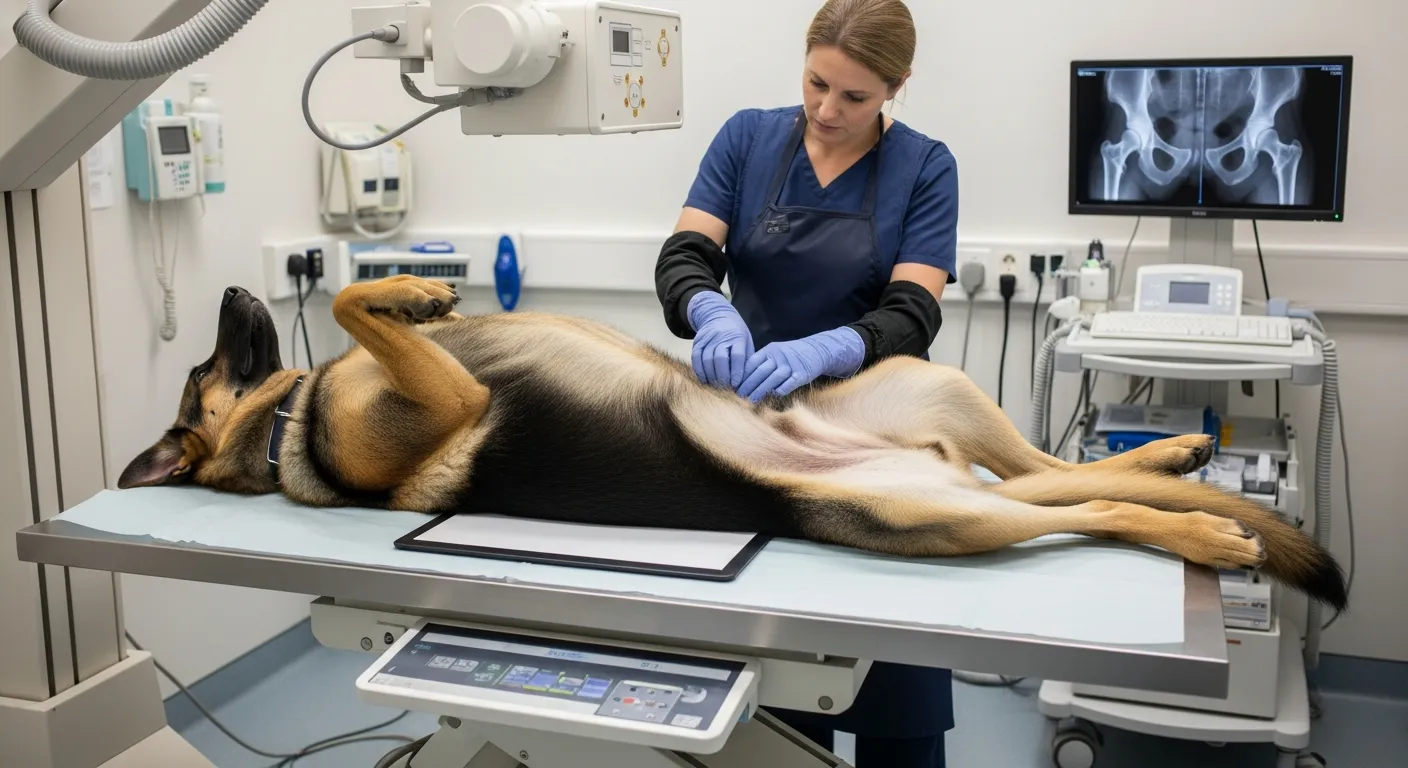
I look for specific markers that distinguish normal aging from a dysplasia crisis requiring intervention. Consistent reluctance to bear weight on one rear limb suggests the joint has crossed from chronic discomfort to acute pain, often triggered by a cartilage fragment breaking free or an osteophyte fracturing. Crossing of the rear legs during standing indicates neurological involvement, which can develop when chronic postural compensation affects the lumbosacral spine. Muscle mass asymmetry between the two rear limbs, visible as one thigh appearing noticeably thinner, signals that the dog is offloading one hip significantly.
The morning stiffness pattern tells me a great deal. All arthritic dogs are stiff when they first rise. A dog who works through stiffness in five to ten minutes has manageable disease. A dog who remains stiff for thirty minutes or longer, or who never fully loosens up, needs aggressive reassessment of their pain management protocol.
Reassessing Pain Management in Older Dogs
The NSAID that served the dog well for years may need reconsideration as organ function changes. Kidney values creep upward. Liver enzymes fluctuate. The gastrointestinal lining becomes more vulnerable. I am not suggesting NSAIDs must be abandoned in senior dogs; rather, the risk-benefit calculation shifts and requires more frequent monitoring.
Blood work every three to four months becomes essential for any senior dog on chronic NSAID therapy. I specifically track BUN, creatinine, SDMA, liver enzymes, and hematocrit. A rising creatinine trend, even within normal range, prompts me to reduce the NSAID dose or switch to a drug with a different metabolic pathway. Meloxicam at a reduced dose often works where full-dose carprofen no longer seems safe.
The emergence of grapiprant (Galliprant) has been genuinely helpful for senior dysplastic dogs. As a piprant-class drug rather than a traditional NSAID, it targets the EP4 prostaglandin receptor specifically without the broader COX inhibition that stresses kidneys and the GI tract. Its safety profile in dogs with compromised renal function is notably better. The trade-off is that its analgesic potency for severe osteoarthritis may fall short of what a traditional NSAID achieves. I often use it as a baseline medication and add tramadol or gabapentin for breakthrough pain rather than escalating the anti-inflammatory dose.
Gabapentin deserves particular mention for senior dogs. At 5-10 mg/kg two to three times daily, it addresses the neuropathic pain component that develops in chronic osteoarthritis. The initial sedation that concerns many owners typically resolves within a week as the dog adjusts. For dogs whose pain has a clear neurological component, manifesting as sensitivity to light touch over the hips or exaggerated withdrawal reflexes, gabapentin can transform their comfort level in ways that NSAIDs alone cannot.
The Multimodal Approach: Beyond Pharmaceuticals
Relying solely on medication for a senior dysplastic dog is both insufficient and risky. The most successful management plans I oversee combine pharmaceutical pain control with physical rehabilitation, environmental modification, and meticulous weight management. Each component reduces the burden on the others.
Physical rehabilitation for senior dogs emphasizes maintaining what remains rather than building new capacity. Gentle range-of-motion exercises performed daily prevent the joint capsule from contracting further. Passive flexion and extension of the hip, held for 15-20 seconds at end range, maintains mobility that would otherwise be lost month by month. These exercises require no equipment, take five minutes, and can be performed by any owner after brief instruction.
Therapeutic laser therapy has become a standard part of my senior dog protocols. Class IV laser applied over the hip joints twice weekly reduces inflammation at the cellular level and appears to provide genuine pain relief lasting several days per session. The evidence base is stronger than for most physical modalities, and the treatment is quick, painless, and carries essentially no risk.
Swimming therapy remains valuable for senior dogs but requires modification. Sessions should be shorter, water temperature warmer, and recovery time longer. A senior Shepherd who swam twenty minutes at age five may only tolerate eight to ten minutes at age ten. The benefit per minute remains as high as ever, but the total tolerable volume decreases. Watch carefully for post-session stiffness the following day and adjust accordingly.
Environmental Modifications That Matter
The modifications that seem simplest often produce the most noticeable improvement in a senior dog's daily life. Hardwood and tile floors are the enemy of dysplastic dogs. Their hind legs splay on slick surfaces, causing pain, anxiety, and occasionally acute muscle strains. Carpet runners along the dog's primary routes through the house, rubber-backed mats at food and water stations, and yoga mats beside the bed where the dog rises in the morning transform the experience of moving through the home.
Raised food and water bowls reduce the need to lower the front end, which shifts weight backward onto compromised hips. The correct height places the bowl rim at the dog's lower chest level. This small change often increases food intake in dogs who had been eating less because the posture was uncomfortable.
Ramps for getting into vehicles and onto furniture the dog is accustomed to using eliminate the impact loading of jumping. A single jump down from an SUV cargo area generates forces through the hip equivalent to dozens of walking strides. A well-designed ramp with a non-slip surface and appropriate incline allows the dog to maintain their routine without the joint stress.
Orthopedic beds with memory foam or similar pressure-distributing material reduce stiffness after rest. The dog who sleeps on a thin pad on a hard floor will always rise stiffer than one who sleeps on a quality orthopedic bed. Given how much time senior dogs spend resting, the surface they rest on matters enormously.
These modifications scale with body size. Owners of giant breeds face the same questions earlier and at greater cost, and our guide to screening conversations for giant breeds covers the buyer-side version of that discussion.
When Surgery Is Still an Option
The question of surgery in senior dogs requires honest conversation. Total hip replacement remains technically possible in dogs up to twelve or thirteen years old, and I have performed successful replacements in dogs as old as eleven. But the calculus changes. Anesthetic risk increases. Recovery takes longer. The remaining lifespan over which the dog benefits from the investment is shorter.
I consider THR in a senior dog when conservative management has genuinely failed, meaning the dog's quality of life is poor despite optimal medical management, adequate pain control, and appropriate environmental modification. If the dog is otherwise healthy, with good organ function and reasonable body condition, the surgery itself carries acceptable risk. The one-year survival rate after THR in dogs over eight at our practice remains above 90%.
Femoral head ostectomy (FHO) is a more conservative surgical option that eliminates the painful bone-on-bone contact by removing the femoral head entirely. Recovery is less demanding than THR, and the procedure carries lower anesthetic risk because it is shorter. The functional outcome is less predictable in larger dogs, but for a senior Shepherd who needs pain relief and is not a THR candidate, FHO can restore comfortable mobility.
That caveat about larger dogs applies to the whole screening question, not only to surgery. Readers managing or evaluating large working breeds outside the herding group will find the same scoring logic in our look at hip screening for large working dogs.
The Role of Joint Scoring in Monitoring Progression
Annual radiographic monitoring of a senior dysplastic dog serves a different purpose than in younger patients. We are no longer screening or grading for breeding decisions. We are tracking the rate of osteoarthritis progression to calibrate our management intensity. A joint that shows rapid osteophyte growth over twelve months needs more aggressive intervention than one that appears stable.
For owners interested in understanding how joint scoring systems work and what the numbers actually mean for their dog's prognosis, the comprehensive joint scoring guide at Elbow Score Database explains the methodology clearly. While their focus is elbow scoring, the principles of standardized joint evaluation apply across all orthopedic assessments and help owners interpret what their veterinarian is measuring.
I also monitor radiographs for secondary changes that affect treatment decisions. Lumbosacral disease, common in senior Shepherds, can develop alongside hip dysplasia and produce overlapping symptoms. Stifle osteoarthritis from chronic abnormal gait mechanics may become the primary pain source even though the hips started the cascade. Identifying which joints contribute most to the dog's current dysfunction determines where we focus treatment.
Scoring discipline matters beyond the monitoring context as well. When owners go on to evaluate breeders or compare puppies, a documented grade is evidence and an attractive photograph is not; our piece on why hip scores outrank looks in shepherd breeds develops that buyer-side argument.
Nutrition and Supplementation in the Senior Dysplastic Dog
Caloric needs decrease as dogs age and their activity level drops. The senior dysplastic dog faces a paradox: they need fewer calories to avoid weight gain, but they need more protein to combat sarcopenia, and they benefit from specific nutrients that support joint health. A senior-formulated diet with enhanced protein content (minimum 28-30% dry matter basis), moderate fat, and added omega-3 fatty acids addresses all three priorities.
Fish oil supplementation at 30-50 mg/kg EPA+DHA daily continues to provide modest anti-inflammatory benefit. In senior dogs, the anti-inflammatory effect may be more noticeable because the background inflammation level is higher. I consider fish oil a lifelong supplement for any dysplastic dog, from diagnosis through their senior years.
Glucosamine and chondroitin remain controversial. The evidence for clinical efficacy is weak, but the supplements carry essentially no risk and some owners report subjective improvement. I neither recommend nor discourage them. If an owner wants to try them, I ask for a three-month trial with honest assessment of whether function improves. Most of the time, the answer is no meaningful change. The money would be better spent on physical rehabilitation sessions.
Adequate hydration matters more in senior dogs than most owners realize. Dehydration increases synovial fluid viscosity in the wrong direction, thickening it when you want it thin and slippery. Multiple water stations, flavoring water with low-sodium broth to encourage drinking, and monitoring urine concentration all help maintain the joint fluid environment.
Quality of Life Assessment: The Honest Conversation
There comes a point in every chronic disease where the most important clinical skill is honesty. I have watched owners pour extraordinary effort and resources into managing their senior dog's hip dysplasia, and I admire that devotion. But I owe it to my patients to be candid when the disease has progressed beyond what management can meaningfully address.
I use a structured quality of life assessment that evaluates five domains: pain control (is the dog comfortable most of the time?), mobility (can the dog move independently for basic functions?), appetite and hydration (is the dog eating and drinking willingly?), hygiene (can the dog maintain cleanliness or does incontinence or inability to posture cause soiling?), and engagement (does the dog still interact with family, show interest in surroundings, and experience moments of obvious enjoyment?).
When three or more of these domains are consistently compromised despite maximum medical and supportive management, I gently raise the conversation about end-of-life planning. This is never about giving up. It is about recognizing that the dog's suffering has reached a threshold that our interventions cannot reduce to an acceptable level. The decision belongs entirely to the owner, but they deserve an honest clinical perspective to inform it.
Many of the dogs I follow never reach that point. With diligent management, the majority of dysplastic Shepherds live full lives, comfortable and mobile into their eleventh and twelfth years. The senior phase requires more attention, more frequent veterinary visits, and more willingness to adjust the plan. But the years of companionship those adjustments preserve are among the most meaningful an owner will experience.
As a small breed ages, daily care shifts from routine to observation. Walks get shorter but more frequent, nails need trimming more often because wear decreases, and dental checks move to the front of the list. Warm bedding matters more, and stairs become a negotiation. For a German Spitz, coat care also changes: the undercoat thins, so brushing becomes gentler and skin checks more regular. If you keep a Spitz, review German Spitz care routines as the dog moves through its senior years, and adjust feeding, exercise and handling to what the dog shows you each week.