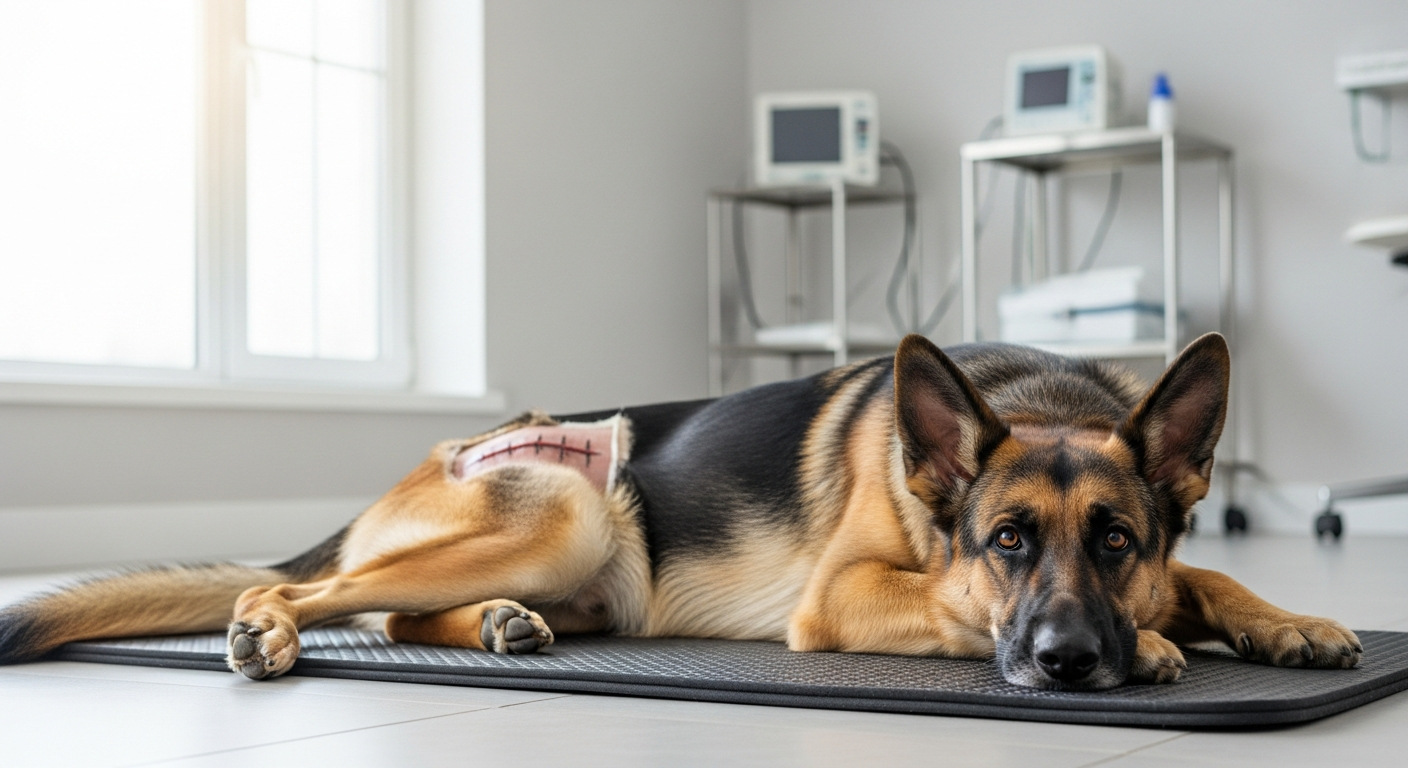
Femoral head ostectomy — commonly shortened to FHO — is one of the most misunderstood procedures in canine orthopedic surgery. Owners hear it described in extremes. Either it is the simple salvage procedure that magically restores comfort to a painful dysplastic dog, or it is the procedure a vet performs when they cannot afford a total hip replacement and the outcome is an unpredictable gamble. Neither framing is correct. This article covers what FHO actually is, where it belongs in the shepherd-breed orthopedic toolkit, and how to read the outcome data honestly when you are making this decision for your dog.
What the Procedure Actually Does
FHO removes the femoral head — the ball of the ball-and-socket hip joint — and with it the articulating surface between femur and pelvis. The dog is left without a formal hip joint on the operated side. In place of the joint, a fibrous pseudo-joint develops over several months as the surrounding muscles and connective tissue organize around the new anatomy.
The procedure is performed through a relatively short surgical approach, takes about 45 minutes in experienced hands, and does not require the implants, specialized instrumentation, or precision that total hip replacement demands. It is, surgically speaking, a simpler operation.
The point of removing the head is to eliminate the painful bone-on-bone grinding that occurs when a dysplastic or arthritic hip joint cannot be reconstructed or preserved. The pseudo-joint that develops in place transmits load through soft tissue rather than bony articulation. Done successfully, the result is a functional, comfortable dog — albeit one whose hip mechanics are altered compared to a normal joint.
Where FHO Belongs in the Shepherd-Breed Treatment Tree
FHO is not a first-line intervention for dysplastic shepherds. It is a salvage procedure — meaning its role is to address end-stage joint failure when joint preservation or joint replacement is not possible or not chosen. The hierarchy of considerations I walk owners through generally looks like this:
- Optimize conservative management, including weight, exercise, NSAIDs, and rehab
- Consider total hip replacement for appropriate surgical candidates
- Evaluate triple pelvic osteotomy or double pelvic osteotomy in young dogs with specific dysplastic profiles (increasingly rare indication)
- Consider FHO as a salvage option when the above are not feasible or not successful
In this framework, FHO is not the "poor cousin" of total hip replacement. It is a different tool for a different situation. Dogs with failed THRs, dogs with severe osteoarthritis where replacement is contraindicated, and dogs whose owners cannot pursue bilateral THR but do need to address severe unilateral pain are all legitimate FHO candidates.
Size, Conformation, and Outcomes
The persistent clinical lore is that FHO outcomes correlate inversely with body weight — that small dogs do well and large dogs do poorly. The data are more nuanced than this suggests.
What the better studies support: FHO outcomes depend more on pre-surgical muscle mass, post-surgical rehabilitation commitment, and individual conformation than on raw body weight alone. A muscularly well conditioned 35 kg German Shepherd whose owner is committed to a structured rehab program has a meaningfully better prognosis than an atrophied, unfit 25 kg Border Collie whose owner does not engage with rehab.
That said, conformation matters. Breeds with heavy forequarters and long backs transfer load differently from breeds with more even balance, and outcomes do vary systematically. The table below reflects what I have come to expect across shepherd and herding breed FHOs in my own practice:
| Patient profile | Expected functional outcome | Rehab commitment required |
|---|---|---|
| Small herding breed, good muscle mass | Near-normal gait, full activity | Moderate |
| Medium shepherd, pre-op rehab optimized | Good functional outcome, some mechanical gait change | High |
| Large German Shepherd, optimized | Acceptable functional outcome, persistent mechanical gait | Very high |
| Large shepherd, poor muscle, limited rehab | Modest outcome, chronic dysfunction likely | Limited engagement |
| Bilateral FHO, any size | Significant gait change, requires committed rehab | Very high |
Rehabilitation Is Not Optional
The single most important variable in FHO outcomes is rehabilitation. The pseudo-joint that develops after surgery is literally built by the movement the dog does. A dog that is confined and protected after surgery develops a stiffer, less functional pseudo-joint than a dog that is actively rehabilitated through a structured program.
The rehab protocol I favor for shepherd-breed FHO patients begins within 48 hours of surgery, emphasizes early controlled range of motion, progresses through underwater treadmill work and targeted strengthening, and extends across 12 to 16 weeks. I also strongly encourage integration of physiotherapy protocols and, where accessible, swimming therapy.
Owners who consent to FHO without understanding the rehab commitment are often disappointed by the outcome. Owners who understand what the procedure requires and commit to the work typically report satisfaction with the result.
What Owners Should Expect in the First Year
The first two weeks post-op are sore, incision-focused, and limited to controlled movement. Weeks three to six are the window when most owners begin to notice meaningful gait improvement. Weeks six to twelve are when the pseudo-joint matures and sustained functional gain accumulates.
At six months, a successful FHO in a shepherd-breed dog looks like this: the dog is weight-bearing comfortably, has resumed most normal activity at appropriate intensity, may show a subtle mechanical gait difference on the operated side, and is demonstrably more comfortable than pre-surgery. The altered gait is typically not progressive and does not cause ongoing pain when the pseudo-joint has matured normally.
When FHO Is Not the Right Answer
I do not recommend FHO when total hip replacement is feasible, the owner is committed, and the dog is an appropriate candidate. The functional outcome of a well-performed THR in a large shepherd breed is genuinely superior to the best FHO outcome. If the only reason to choose FHO is cost, the conversation deserves careful exploration of financing, staging options, or insurance before defaulting to the simpler procedure.
I also hesitate with bilateral FHO in large shepherds where unilateral rehab has not yet been attempted. The functional burden of bilateral pseudo-joints in a 35+ kg dog is substantial. Staged THRs, or unilateral FHO with maximal preservation of the contralateral hip, are often preferable.
The Practical Summary
Femoral head ostectomy is neither a magic solution nor a desperate last resort. It is a well-established salvage procedure that, performed thoughtfully in appropriate candidates with committed rehabilitation support, produces genuinely good outcomes for a meaningful proportion of dysplastic shepherd-breed patients. The key determinants of outcome — body condition, rehab commitment, realistic expectations — are all within the owner's control.
The conversations I have with owners considering FHO now center on those determinants, not on the surgical procedure itself. Surgery without rehab is disappointing. Surgery with a committed rehabilitation plan is, in the right patient, transformative. The American College of Veterinary Surgeons maintains current position documents on canine hip salvage procedures that are worth reviewing if you are weighing this decision for your own dog.